If you sell homemade cookies, one of the hardest questions to answer is simple: how much should I charge? Many home bakers guess, copy competitors, or just double their ingredient cost without truly understanding their numbers. That approach often leads to underpricing, inconsistent profits, and burnout.
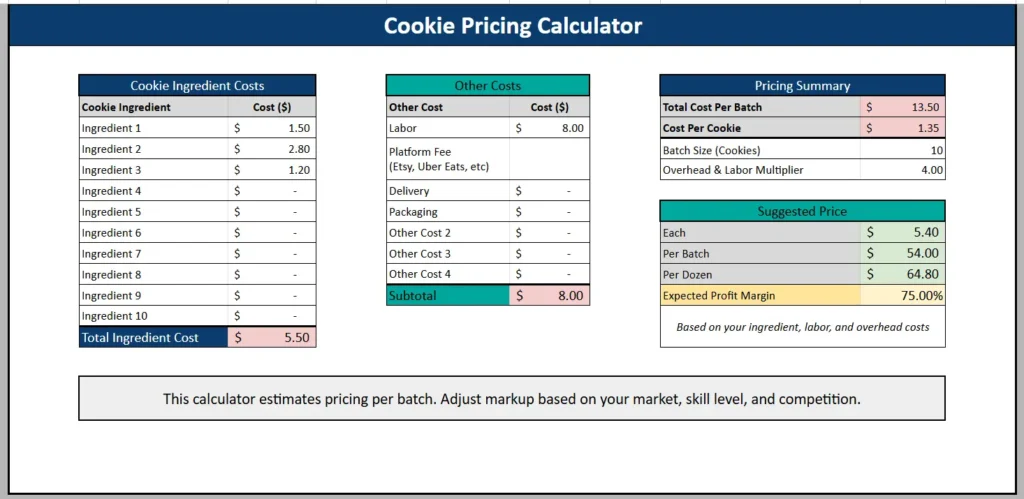
This cookie pricing calculator was designed to remove the guesswork. Instead of estimating, you enter your actual ingredient costs, labor, and other expenses, and the spreadsheet calculates your true cost per batch, cost per cookie, and suggested selling price based on your chosen multiplier.
The calculator comes with two sheets:
- A clean, branded main calculator for everyday use
- A fully filled-out example sheet showing chocolate chip cookie pricing in action
Both sheets function as working calculators. The example simply demonstrates how realistic numbers flow through the formulas so you can see exactly how pricing decisions affect profit.
Whether you are selling at a farmers market, taking custom orders for birthday parties, running a cottage food business, or listing cookies on Etsy, this cookie pricing calculator gives you clarity. Instead of asking “What should I charge?”, you will know.
Key Features and Sections
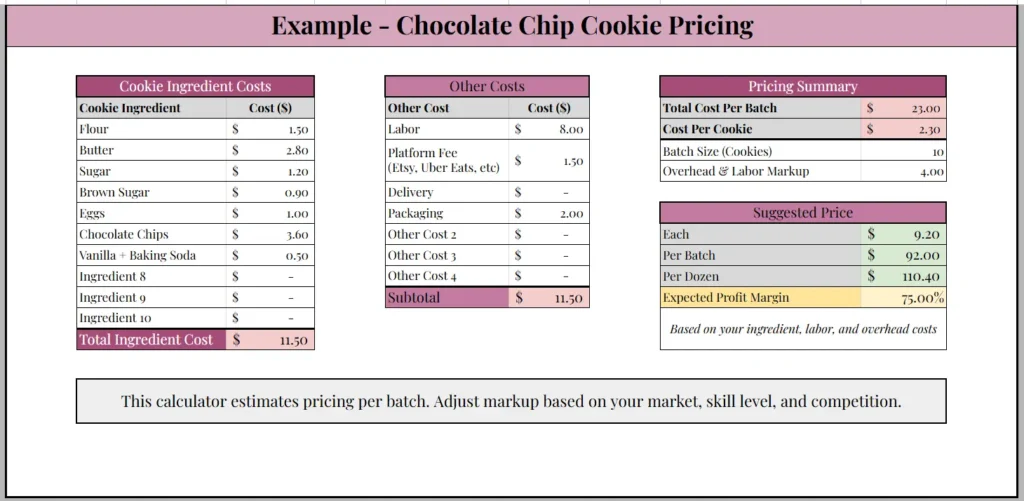
The spreadsheet is organized into three main sections that work together to calculate accurate pricing: ingredient costs, other costs, and pricing summary. Each section plays a specific role in determining your final price.
Cookie Ingredient Costs
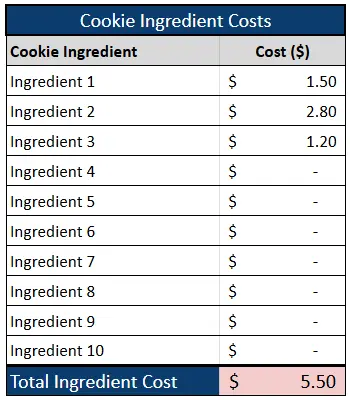
This section is where you enter the direct cost of ingredients used in one batch.
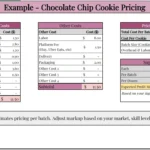
For example, in the chocolate chip cookie example sheet, the ingredient list includes:
- Flour
- Butter
- Sugar
- Brown Sugar
- Eggs
- Chocolate Chips
- Vanilla + Baking Soda
Each ingredient has its own cost column. You only enter the amount actually used for that batch, not the entire package cost. If a bag of chocolate chips costs $6 but you use half, you would enter $3.
At the bottom, the spreadsheet automatically calculates Total Ingredient Cost. In the example sheet, that total comes to $11.50.
This section is crucial because many bakers underestimate their true ingredient expense. Even small amounts like vanilla or baking soda add up over time. By listing each ingredient individually, you avoid missing hidden costs.
Other Costs
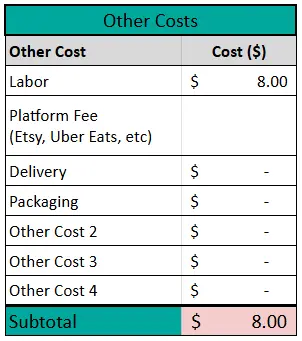
Ingredients are only part of the picture. This section accounts for everything else required to produce and sell your cookies.
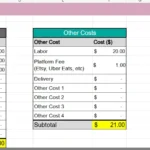
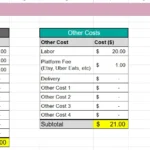
In the example sheet, you will see:
- Labor
- Platform Fee (Etsy, Uber Eats, etc.)
- Delivery
- Packaging
Labor is especially important. Many home bakers forget to pay themselves. Even if you only allocate $8 for a batch, that number needs to be included or your business will never scale sustainably.
Packaging is another common oversight. Boxes, labels, bags, ribbons, and stickers all contribute to the final cost.
At the bottom of this section, the Subtotal automatically sums all additional costs. In the example, other costs total $11.50.
When combined with ingredients, this creates a realistic Total Cost Per Batch.
Pricing Summary
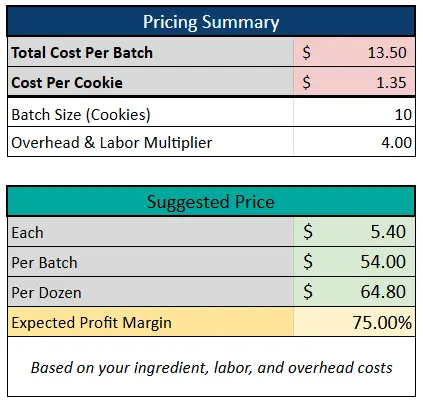
This is where the calculator does the heavy lifting.
The summary displays:
- Total Cost Per Batch
- Cost Per Cookie
- Batch Size (Cookies)
- Overhead & Labor Markup (Multiplier)
- Suggested Price (Each, Per Batch, Per Dozen)
- Expected Profit Margin
Let’s break that down using the example.
Total Cost Per Batch is $23.00.
Batch Size is 10 cookies.
The spreadsheet automatically calculates Cost Per Cookie at $2.30.
You then enter a pricing multiplier. In the example, the multiplier is 4.00. That means you are charging four times your cost per cookie.
The calculator instantly generates:
- Price Per Cookie: $9.20
- Price Per Batch: $92.00
- Price Per Dozen: $110.40
- Expected Profit Margin: 75%
This structure makes pricing decisions simple. Instead of manually calculating markup percentages, you adjust one multiplier and see immediate results.
How to Use the Template
Using this cookie pricing calculator takes only a few minutes, but it can completely change how you price your products.
Step 1: Enter Ingredient Costs
Start by listing every ingredient used in one batch. Break it down realistically. If you use one egg from a $4 carton of 12, divide accordingly. The more accurate you are here, the more reliable your final price will be.
Step 2: Enter Other Costs
Add labor, packaging, and any selling fees. Even if you are not currently selling on a platform, consider future growth. Adding a small buffer now can prevent underpricing later.
If you work from home, you might choose to include a small utilities allocation. If you plan to expand, you could add overhead such as equipment depreciation.
Step 3: Confirm Batch Size
Enter the number of cookies produced in one batch. This directly impacts cost per cookie.
If you produce 20 cookies instead of 10, your cost per cookie changes automatically. This flexibility makes the spreadsheet useful for experimenting with different batch quantities.
Step 4: Adjust the Multiplier
This is where strategy comes in.
A multiplier of 2.0 may work for very basic home baking.
A multiplier of 3.0 is common for small food businesses.
A multiplier of 4.0 or higher is typical for decorated or custom cookies.
Change the multiplier and observe how:
- Price per cookie shifts
- Per dozen pricing adjusts
- Profit margin recalculates
This allows you to test pricing scenarios before committing to your final numbers.
Step 5: Review Profit Margin
The Expected Profit Margin is calculated automatically. This helps you see whether your pricing supports your goals.
If the margin is too low, consider:
- Increasing your multiplier
- Reducing ingredient waste
- Raising batch size
- Streamlining labor time
The spreadsheet gives you data to make informed decisions.
Why Choose This Template
There are many generic pricing formulas online, but this cookie pricing calculator stands out for a few key reasons.
It is practical.
The layout mirrors how real bakers think: ingredients, labor, and final selling price.
It is beginner-friendly.
You do not need advanced accounting knowledge. The multiplier system simplifies pricing without sacrificing accuracy.
It is flexible.
You can use it for chocolate chip cookies, decorated sugar cookies, gluten-free batches, holiday assortments, or wholesale orders.
It is realistic.
The example sheet demonstrates exactly how numbers flow through the calculator. You are not starting with a blank page and guessing what to enter.
It is scalable.
As your business grows, you can adjust labor rates, packaging upgrades, or platform fees without rebuilding your pricing structure from scratch.
Most importantly, it helps prevent underpricing. Many talented bakers quit because they charge too little and feel overwhelmed. When you know your cost per cookie and your target profit margin, you price with confidence.
If you are serious about selling cookies profitably, this calculator gives you a structured, repeatable system you can rely on.
Download Your Free Cookie Cost Calculator Spreadsheet
- Free Template
- Fully Editable
- Instant Access
- Organize your information
How to Access Your Copy
- Enter your email for instant access
- Open the link we send you
- Start using the spreadsheet right away